

Matthew, also called Levi, to whom the Gospel of the same name is attributed, was a tax collector of Herod Antipas. Providing his service to the Romans, he was pointed out as a publican and hated by the Pharisees. Son of Alphaeus, he lived in Capernaum. When Jesus called him, he freed himself of all his possessions and followed him. He preached first in Palestine and then in other countries of Asia Minor and Central Asia, especially in Ethiopia, not the African one, but an ancient region of Asia Minor.
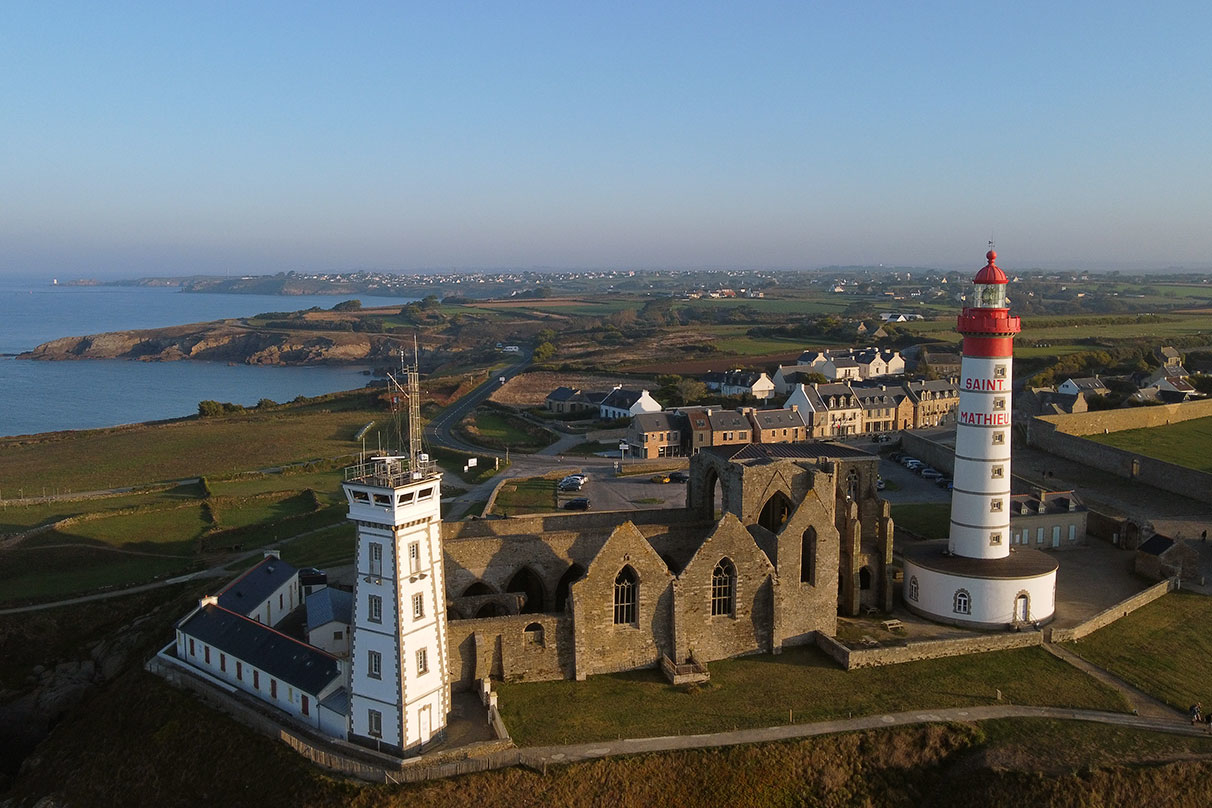
According to the Golden Legend of Jacobus de Voragine, Matthew was beheaded with a sword while celebrating mass. The date of his death is unknown but it is believed that it always occurred in Ethiopia and that he was buried there until his remains appear in Brittany, in the north-west of France, according to the Sermo sancti Paolini (Codex Vaticanus Lateranense 577, ff. 35v-42). It is said that the remains of the evangelist’s body were transported by some Breton sailors and merchants from Léon, who were miraculously saved from a shipwreck off the point still called Punta San Matteo (Pointe Saint Mathieu, Le Conquet).
Towards the middle of the 5th century, during a Roman military campaign aimed at countering the advance of the Huns, the Roman military prefect Gavinio took the remains of the apostle from Brittany to take them to Lucania in Italy, and precisely to Velia, his native land. Here they remained for about four centuries.
The body was found in the 10th century, near a thermal spring and a domus in the ancient baths of Velia, by the monk Anastasius on the instructions of his mother Pelagia, to whom Saint Matthew appeared in a dream. Anastasius hid it in a chapel located in the place called “ad duo flumina” which today belongs to the municipality of Casal Velino. What we can see today is a new chapel built on the site where the ancient one stood.
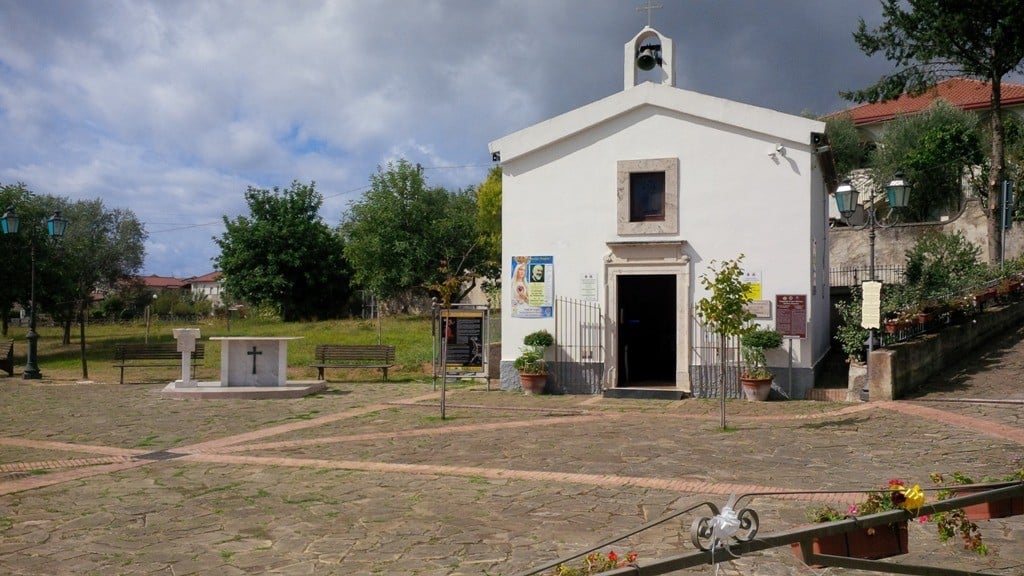
From there, the remains were transferred to the sanctuary of the Madonna del Granato in Capaccio-Paestum with a prior stop in Rutino where, according to tradition, a spring miraculously gushed forth that quenched the thirst of the bearers of the saint’s body.
In 954 the relics of the apostle were transferred to Salerno at the behest of the Longobard prince Gisulfo I. The story of the transfer is told in chapter 165 of the Chronicon Salernitanum, a chronicle written around 978 by an anonymous monk from the monastery of Saint Benedict in Salerno.
After the Norman conquest of the city by Robert the Guiscardo in 1076, construction began on the current Cathedral, in whose crypt the remains of the Saint were placed at the behest of Archbishop Alfano I. The work on the cathedral was completed in 1084 with the consecration of Pope Gregory VII, who had taken refuge in exile in the city.
In the tomb in Salerno, inside of two urns, the body of the Saint is venerated almost in its entirety. In fact, the head and the phalanx of a finger of the Evangelist were stolen or purchased by a Breton crusader who, passing through Salerno, was returning from the Fourth Crusade. Once he reached his homeland, he delivered the relics to Hervè II, Count of Leon (1160-1208), which were placed in very precious cases and donated to the abbey of Le Conquet where the remains of a basilica in honor of the Saint still exist today. The riots of the French Revolution led to the dispersion of the reliquaries.
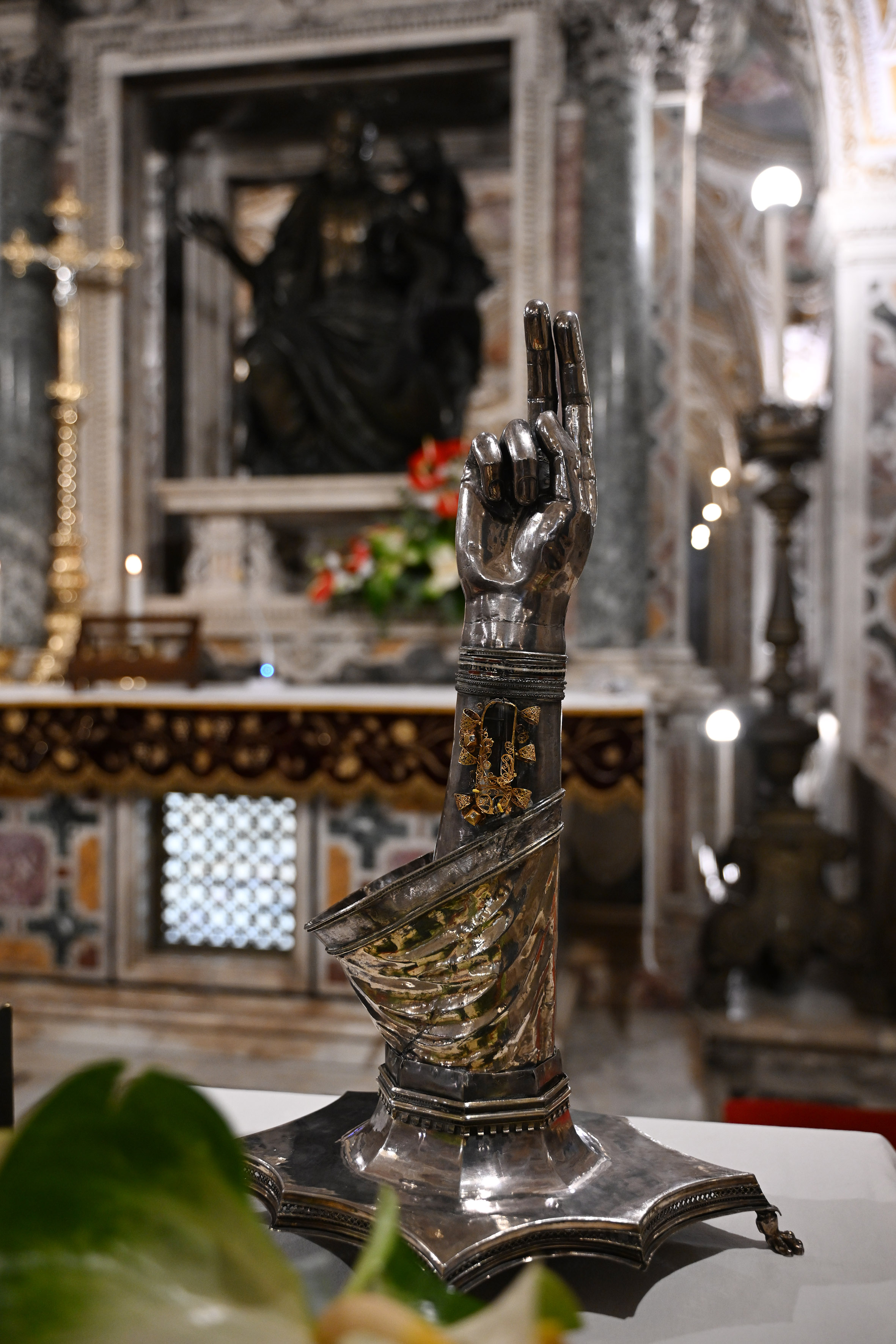
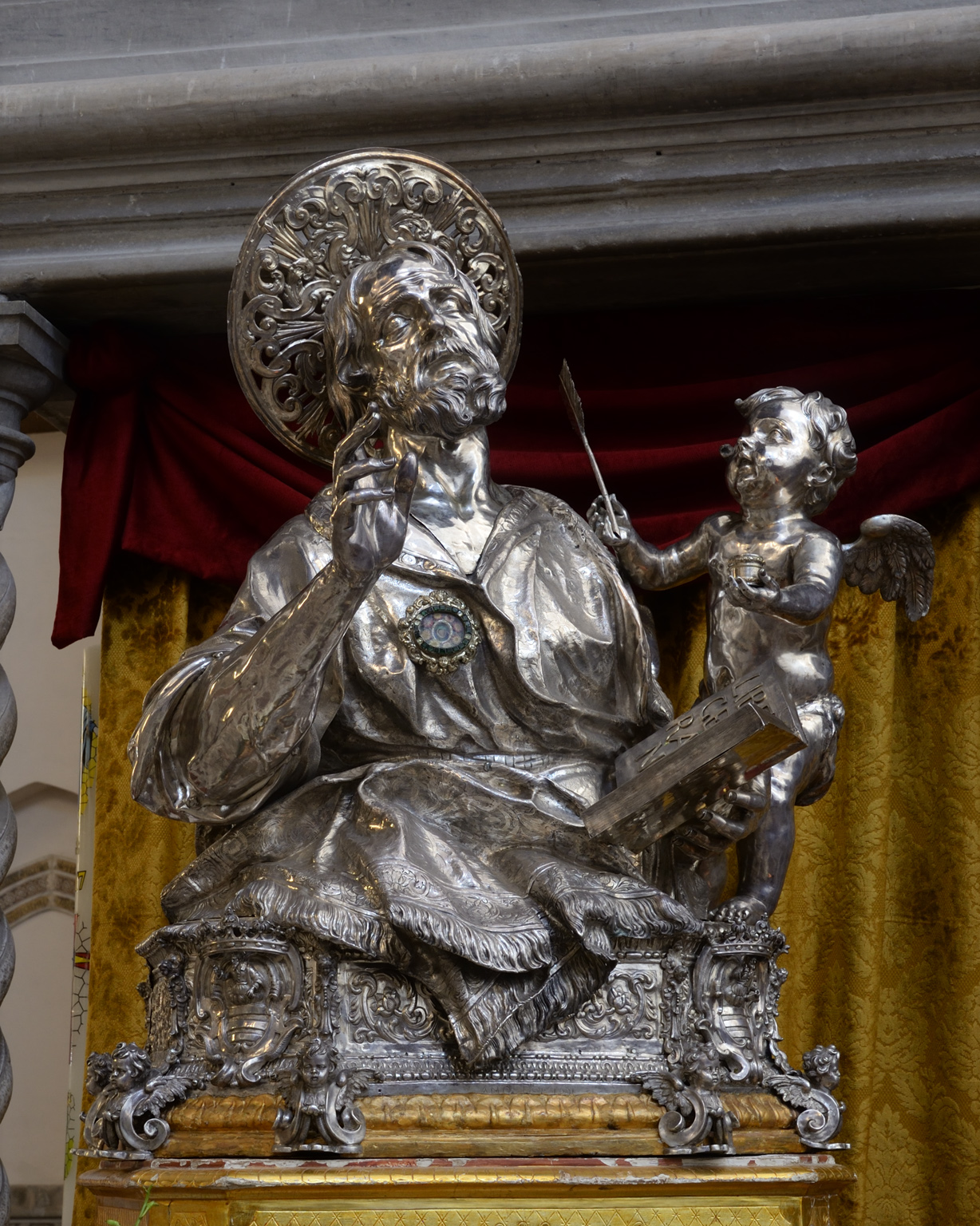
In Salerno, in addition to the remains kept in the Crypt, the relic of the apostle’s arm is also preserved, placed in a special silver reliquary (f.1) and a tooth contained in a silver and gold medallion, set in the half-length statue of the Saint (f.2). These relics are exposed for the veneration of the faithful in the Treasury Chapel, located inside the Sacristy of the Upper Basilica.
Other relics, coming from Salerno, are preserved in Rome, in Casal Velino (SA) and in San Marco in Lamis (FG).
 Unità Pastorale Centro Storico